
How to Read a Roofing Estimate Like a Tampa Bay Contractor
Published August 15, 2026 | Brandon Roofing — Tampa Bay, FL
You requested three roofing estimates. One is a single page with a number at the bottom. Another is four pages of line items you have never seen before. The third falls somewhere in between. They are all for the same roof, but the prices are thousands of dollars apart.
Which one do you trust? Not the cheapest one — the one you can actually read. Most Tampa Bay homeowners make their roofing decision based on the bottom-line number, and that is exactly how bad contractors win the job. A legitimate roofing estimate is a detailed, line-by-line document that tells you what you are paying for, what materials will be used, and what happens when something goes wrong.
The Line Items Every Legitimate Estimate Should Have
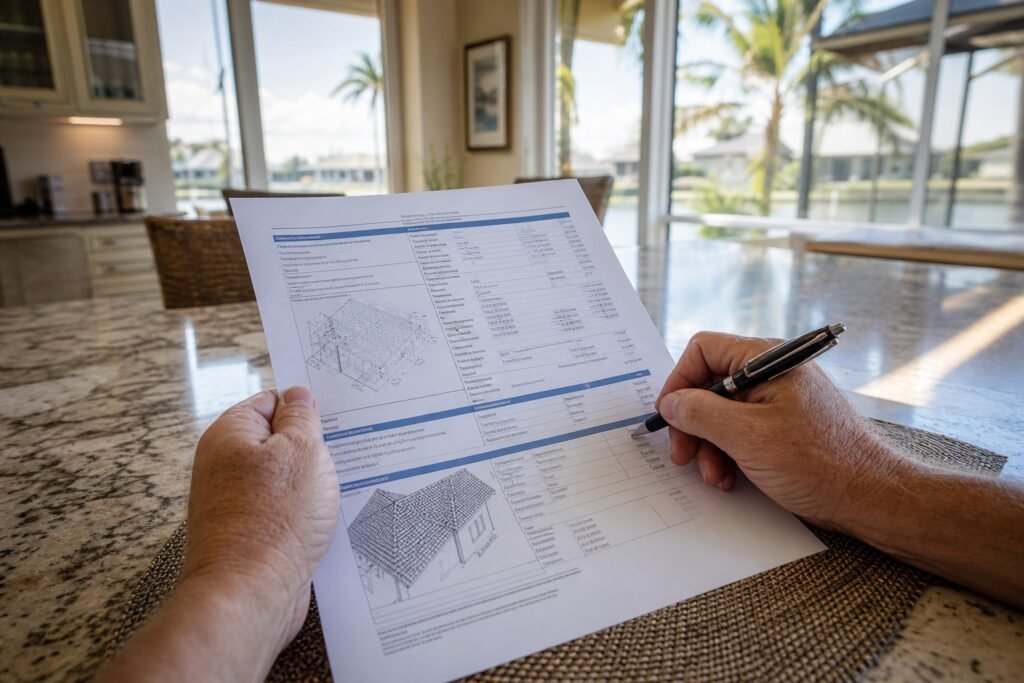
A professional roofing estimate in 2026 should contain distinct line items — not a single lump-sum number. Here is what to look for and why it matters for Tampa Bay homeowners.
Tear-off and disposal. This covers removing your existing roofing material and hauling it to a licensed disposal facility. In Hillsborough County, most residential re-roofs require a full tear-off down to the deck — Florida Building Code does not allow a third layer of shingles. If your estimate says “overlay,” ask why. Your insurer may not cover it, and it can void manufacturer warranties.
Decking replacement allowance. Once the old shingles come off, your contractor inspects the plywood or OSB sheathing underneath. In Tampa Bay’s humidity, rotted decking is common. A trustworthy estimate includes a per-sheet price for replacement — typically $85 to $110 per sheet installed in this market — with an allowance for a specific number of sheets. If decking is not mentioned at all, the contractor is planning to charge you extra later or roof over damaged wood.
Drip edge and flashing. L-shaped metal drip edge runs along your eaves and rake edges. Florida Building Code (R905.2.8.5) requires it with a 3-inch lap and specific fastening patterns. Flashing at every wall junction, chimney, skylight, and pipe penetration should also be itemized — skimping on flashing is the number-one cause of premature roof leaks in Tampa Bay.
Underlayment. The waterproof layer between your roof deck and shingles is arguably the most critical component in Florida. The estimate should specify synthetic underlayment for standard slopes or peel-and-stick for low-slope sections. Tampa Bay sits in the Wind-Borne Debris Region under the Florida Building Code 8th Edition, which means secondary water barrier requirements apply (FRC R908.7.2). If your estimate just says “felt paper,” ask questions.
Shingles — with manufacturer and product name. The estimate should name the exact product line — not just “architectural shingles” but something like “GAF Timberline HDZ Charcoal.” Generic descriptions allow contractors to substitute cheaper products without technically breaking the contract. In Tampa Bay, architectural shingle replacements typically run $550 to $650 per roofing square (100 square feet) for standard installations.
Ventilation. Ridge vent and soffit intake should be specified with linear footage. Florida Building Code (Section 1503.5) requires ventilation, and improper ventilation in our climate accelerates shingle deterioration and drives up cooling costs.
Pipe boots, roof vents, and ridge cap. Every plumbing vent and exhaust fan needs a new boot during a re-roof. Ridge and hip cap shingles should match your field shingle manufacturer. These components are cheap to replace during installation and expensive to fix when they fail two years later.
Permit fees. Hillsborough County requires a permit for every re-roof. A contractor who says a permit “is not necessary” is a contractor you should not hire. Re-roofing without a permit creates serious problems when you sell your home or file an insurance claim.
Warranty and payment terms. The estimate should specify both the manufacturer warranty (typically 25–50 years on materials) and the contractor’s workmanship warranty (typically 2–10 years on labor). Payment terms should be clear: a deposit of 10 to 20 percent to order materials is standard in Tampa Bay, with the balance due upon completion and final inspection.
The Red Flags That Should Make You Walk Away
Not every incomplete estimate is a scam. But certain patterns should trigger serious caution — especially in Tampa Bay, where storm chasers target neighborhoods after every hurricane season.
Single lump-sum pricing with no itemization. If the entire estimate is “Roof replacement: $14,500,” you have no way to compare it to other bids and no leverage if the contractor substitutes cheaper products.
No license number on the document. Florida law requires roofing contractors to hold a CCC (Certified Roofing Contractor) or equivalent license. The estimate should include the contractor’s license number, insurance information, and physical business address — not just a phone number and a Gmail address.
Pressure to sign immediately. “This price is only good today” is a sales tactic, not a business reality. Material prices do not change overnight. Legitimate contractors give you time to get competing estimates.
Demanding a large upfront deposit. A deposit of 10 to 20 percent is standard. Any contractor demanding full payment before work begins is a deal-breaker.
Price far below other bids. If one estimate comes in 25 percent or more below the others, the low bid typically reflects omitted scope, inferior materials, or a contractor who does not carry adequate insurance.
How to Compare Estimates Side by Side
Once you have two or three estimates, line them up and compare each line item. Here is a practical approach for homeowners in Brandon, Riverview, Valrico, and across Hillsborough County:
- Check the roof measurement. All estimates should show roughly the same number of roofing squares. If one contractor measured 22 squares and another measured 28, someone made a mistake.
- Match materials by manufacturer and product. Comparing a GAF Timberline HDZ estimate to an Owens Corning Duration estimate is valid. Comparing a branded estimate to one that says “architectural shingles” is not.
- Look at inclusions vs. exclusions. One estimate may include drip edge and deck re-nailing to code (8d ring-shank nails, 6 inches on center per EBC 706.7.1) while another assumes everything is fine. These differences add up fast.
- Verify the permit is included. A “cheaper” estimate without the Hillsborough County permit fee is not actually cheaper.
Three Steps Before You Sign
- Verify the license. Go to myfloridalicense.com and search the contractor’s name or license number. Confirm it is active, the correct type, and has no disciplinary actions.
- Check for complaints. Search the DBPR Unlicensed Activity database. Ask Hillsborough County Development Services at (813) 272-5600 about any complaints on file.
- Read the full contract. The estimate becomes part of the contract. Make sure the final contract references the same materials, scope, and price.
A roofing estimate is not just a price quote — it is a promise. The more specific that promise is, the more likely you are to get the roof you are paying for.
Need help understanding a roofing estimate you have received? Brandon Roofing provides free, itemized estimates for homeowners across Tampa Bay — call us at (813) 538-8200 to schedule yours.
Disclaimer: This article is for informational purposes only and does not constitute legal or financial advice. Florida building codes and contractor regulations are subject to change. Consult a licensed professional for guidance specific to your situation.