
Metal Roofs in Tampa Bay: Are They Worth the Price Difference?
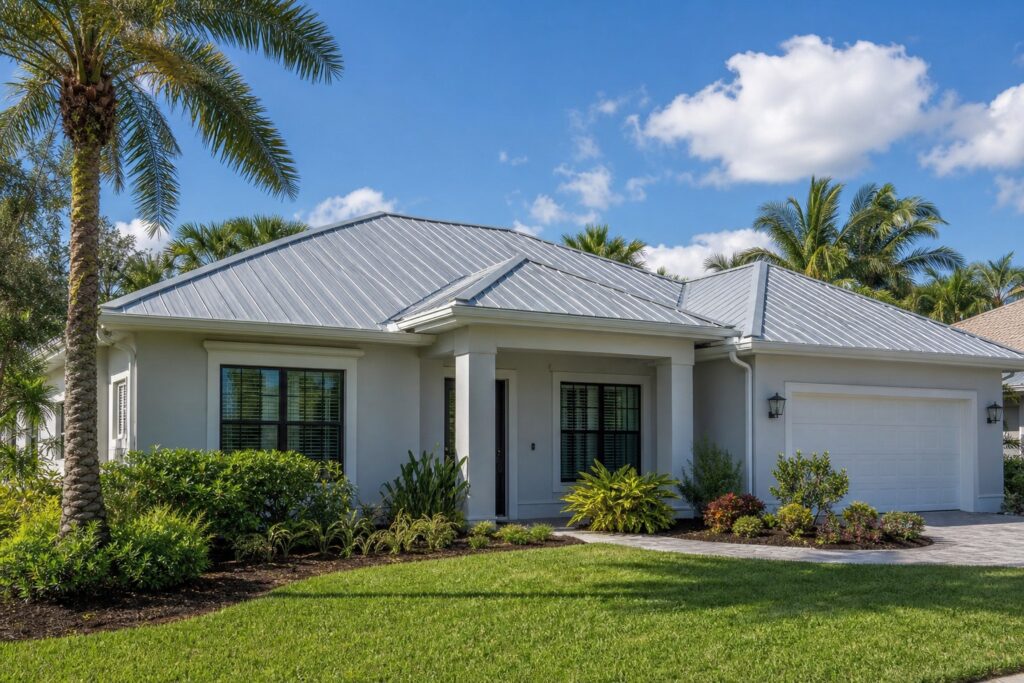
Drive through Tampa, Valrico, Riverview or the older parts of Brandon and you’ll see more standing seam and metal shingle roofs than you did five years ago. Homeowners hear the pitch — “lasts twice as long”, “cuts your power bill”, “insurance loves it” — and then get the estimate and stop cold. Metal typically costs two to three times what an architectural shingle roof costs in the Tampa market.
So is it worth it? The honest answer is that it depends on one thing more than any other: How long do you plan to own the house? Here’s the math, the code reality in Hillsborough County, and where the marketing gets ahead of the data.
What metal actually costs in the Tampa market
Local 2026 pricing guides for the Tampa area put architectural asphalt shingles at roughly $5 to $9 per square foot installed, exposed-fastener metal at about $8 to $14, and standing seam metal at roughly $14 to $25 per square foot. On a typical 2,000-square-foot Brandon home, that’s about $9,000 to $16,000 for architectural shingles versus roughly $20,000 to $36,000 for standing seam.
Those are wide ranges for a reason. Roof pitch, the number of valleys and penetrations, whether the deck needs replacement, and metal gauge and coating all move the number substantially. A simple hip roof over a one-story ranch prices very differently than a cut-up two-story with dormers. Any contractor quoting metal off a satellite measurement without walking the roof is guessing.
The lifespan gap is real — but smaller than the brochures claim
This is where metal earns most of its case. Field-data reporting published in 2026 puts realistic service life for 24-gauge standing seam with a Kynar 500 finish at 40 to 50 years, against a marketing claim of 50. Architectural asphalt shingles rated “30-year” realistically deliver about 20 to 25 years, and closer to 18 to 22 in hot, humid markets — which describes Hillsborough County precisely. The National Roofing Contractors Association’s long-standing technical position is that most new asphalt roofs are designed for roughly 20 years of useful service.
One important caveat: not all metal is the same product. Exposed-fastener metal panels — the more affordable option, and the one that shows up most often on value-priced metal quotes — realistically run 25 to 30 years, not 50. The rubber washers on the exposed screws degrade under Florida UV and thermal cycling and become the maintenance item. If a metal quote seems surprisingly close to shingle pricing, check which system you’re being sold.
Insurance: metal helps, but there’s no “metal roof discount”
Florida law (Section 627.0629, Florida Statutes) requires every residential property insurer in the state to offer premium discounts for specific wind-mitigation construction features. But the wind mitigation form — OIR-B1-1802 — has no line item for roof material. It scores roof shape, roof deck attachment, roof-to-wall connection, secondary water resistance, and opening protection.
Metal tends to score well across several of those categories, which is why homeowners associate it with lower premiums. The credits, though, come from the assembly beneath the metal and the geometry of the roof, not the panel on top. A hip roof with upgraded deck attachment, strapped or clipped roof-to-wall connections, a sealed secondary water barrier, and hurricane-rated opening protection produces a strong score whether the finish is metal or shingle.
Practical implication: if the goal is a lower premium, spend the conversation on those five categories and on getting a current wind mitigation inspection filed with your carrier, not on the material alone. And remember the credits apply to the windstorm portion of your premium — a larger share for coastal Pinellas and south Hillsborough properties than for inland Tampa, Brandon and Valrico.
Heat performance: the strongest non-obvious argument
Florida Solar Energy Center research at its Flexible Roofing Facility measured attic performance across roof types side by side. A vented attic under a white metal roof averaged a summer peak mid-attic temperature about 22 degrees cooler than the same attic under dark asphalt shingles, and reduced roof-related cooling load by roughly 47 percent — translating to about 15 percent overall cooling energy savings in that test. An unfinished Galvalume metal roof reduced roof-related heat gain about 25 percent versus the dark-shingle control.
Two things worth understanding about those numbers. First, the benefit comes largely from solar reflectance, so a dark bronze or charcoal metal panel captures far less of it than a white or high-reflectance finish. Second, roofing is only one path for heat into your house. If your attic is under-insulated or your ducts leak, fixing those is a cheaper route to the same electric bill than a new roof.
The resale reality, and the HOA question
If you’re planning to sell within about seven to ten years, the metal premium is difficult to recover. Zonda’s 2025 Cost vs. Value Report — the industry standard for remodeling ROI — showed metal roof replacement recouping about 50 percent of cost at resale nationally, versus about 68 percent for asphalt shingle. Those are Realtor-estimated values at point of sale, not audited transaction prices, and they’re national rather than Tampa-specific, but the direction is consistent: buyers don’t pay full retail for remaining roof life.
On HOAs: check your CC&Rs before you fall in love with a metal quote. Many Brandon-area planned communities specify approved roof materials and colors. A 2026 bill, SB 924, would have barred Florida HOAs from requiring specific roof materials where the alternative meets code and performance standards — but it died in the Senate Regulated Industries committee on March 13, 2026, and did not become law. For now, your architectural review committee still has that authority.
Code notes specific to Hillsborough County
Most of Hillsborough County sits in Florida’s Wind-Borne Debris Region, so roofing products must carry Florida Product Approval rated for local design wind speeds, with enhanced edge metal and fastening. Tampa Bay is not in the High-Velocity Hurricane Zone — that designation covers only Miami-Dade and Broward — so a local re-roof complies with the statewide Florida Building Code, 8th Edition, rather than HVHZ rules.
Also keep the 25% rule in mind: if 25 percent or more of a roof section is repaired or replaced within 12 months, that section must be brought up to current code. Roofs permitted on or after March 1, 2009 are exempt under SB 4-D. Any re-roof in the county requires a permit through Hillsborough County Development Services — (813) 272-5600 — and an inspection of the nailing pattern before the covering goes on.
So who should actually buy metal?
Metal makes financial sense if you plan to stay in the home 15 years or longer, you want to stop thinking about the roof, you’re choosing a reflective color, and your HOA allows it. Architectural shingles make more sense if you may move within a decade, you need the lowest cash outlay, or your community restricts materials — and a well-installed shingle roof with a properly upgraded deck and secondary water barrier still earns strong wind mitigation credits.
What matters more than the material is the assembly and the installer. A premium metal panel installed over a poorly fastened deck with sloppy flashing will fail before a properly installed shingle roof will.
If you’re weighing the two on a specific Brandon, Riverview or Valrico home, Brandon Roofing will walk your roof, measure it properly, and give you both numbers side by side with the wind mitigation implications spelled out — no pressure either direction. Call (813) 538-8200 for a free inspection.
Published August 1, 2026. Pricing ranges reflect 2026 Tampa-market guides and vary by roof complexity. Insurance discount outcomes depend on your carrier, your policy, and a current wind mitigation inspection; this article is general information, not insurance or legal advice. Verify code requirements with Hillsborough County Development Services before starting work.