
When You Disagree on Roof Damage
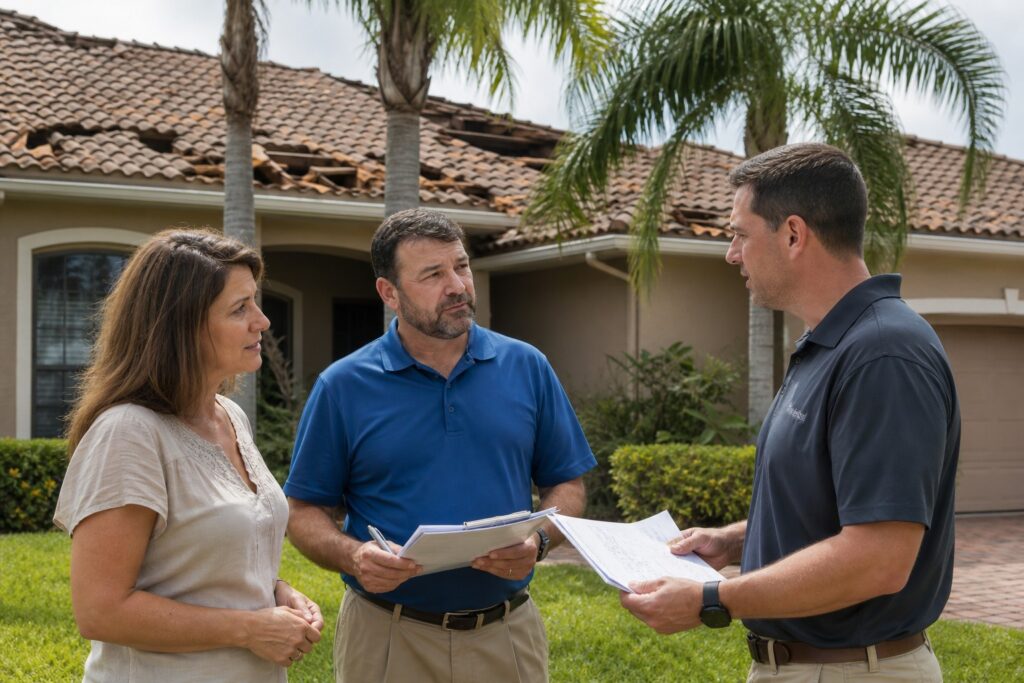
You get a call from your contractor: $18,000 to fix the storm damage on your roof. Then the insurance adjuster shows up, walks the property for 20 minutes, and writes an estimate for $6,200. Suddenly you’re stuck between two professionals giving you wildly different numbers — and your home is the one still leaking.
This scenario plays out thousands of times every year across Tampa Bay. After any significant weather event in Hillsborough County, the gap between what a roofing contractor says your repairs will cost and what the insurance company is willing to pay becomes one of the most stressful parts of homeownership. Here’s how to understand what’s happening, why the numbers almost never match, and what options Florida gives you to fight for a fair outcome.
Why the Numbers Almost Never Match
The first thing to understand is that the disagreement isn’t necessarily because someone is lying. Insurance adjusters and roofing contractors are looking at the same damage through different lenses.
An insurance adjuster works for — or is contracted by — the insurance company. Their job is to evaluate damage that falls within the terms of your policy and assign a dollar value using industry-standard estimating software like Xactimate. They’re trained to identify what’s covered and what isn’t, and to apply the pricing databases their company uses.
Your roofing contractor is looking at what it will actually cost to fix the problem correctly in today’s Tampa Bay market. They’re factoring in current material prices from local suppliers, the labor market in Hillsborough County, code compliance requirements under the Florida Building Code, and any secondary damage they find during tear-off that won’t be visible until work begins.
Common reasons the estimates differ:
- Scope of work: The adjuster may only include visible damage. Your contractor includes everything they expect to find once shingles come off — damaged decking, deteriorated underlayment, compromised flashing.
- Pricing databases: Insurance estimating software sometimes lags behind actual market rates, especially after a major storm when demand spikes across the region.
- Code upgrades: Florida Building Code may require upgrades during a repair that weren’t in place when the roof was originally installed. Insurers don’t always include these costs in the initial estimate.
- Desk adjusting: Some initial estimates are prepared by adjusters who never visit the property. They review photos and documentation remotely, which almost always results in a lower number.
Understanding Who Works for Whom
This is the part most homeowners in Brandon, Riverview, and Valrico don’t fully grasp until they’re in the middle of a claim.
The insurance company’s adjuster — whether a staff employee or an independent adjuster the carrier hired — has a professional obligation to the company that pays them. They aren’t doing anything wrong by writing a conservative estimate. That’s their job. But their incentive structure doesn’t align with yours.
Your roofing contractor works for you, but they also have a financial interest in a larger scope of work. A good, honest contractor will document everything and show you exactly why their number is what it is. A less scrupulous one may inflate the scope.
This is why documentation is your best weapon. Before the insurance adjuster arrives, take timestamped photos from multiple angles, shoot a video walkthrough of the damage, and keep a written log of everything you observe. The evidence you gather before anyone else shows up often determines your outcome.
What a Public Adjuster Does — and What It Costs
If you feel like the insurance company’s estimate is significantly lower than what repairs will actually cost, a public adjuster may be worth considering.
A public adjuster is a licensed insurance professional who works exclusively for you, the policyholder. They’re licensed by the State of Florida, must pass certification exams, and carry their own errors and omissions insurance. Unlike the insurance company’s adjuster, their legal obligation is to act in your best interest.
Here’s what a competent public adjuster handles:
- Thorough inspection: They conduct a detailed inspection of your roof and related damage, often finding issues the insurance adjuster missed or undervalued.
- Policy review: They read your policy in detail and identify all coverage that applies — including coverage you may not have known you had.
- Professional estimate: Using Xactimate (the same software insurers use), they prepare a line-item estimate that speaks the carrier’s language.
- Negotiation: They negotiate directly with the insurance company, presenting evidence and countering objections.
- Supplemental claims: If additional damage is found during repairs, they file supplemental claims for the extra costs.
Public adjusters in Florida work on contingency — you pay nothing upfront. Their fee is typically 10% of the settlement for claims filed after a declared state of emergency, and up to 20% for standard claims. They only get paid if they recover money for you.
It’s not always worth the cost. If the dispute is over a few thousand dollars, the percentage fee may eat into your recovery. But when you’re looking at a $10,000 or $15,000 gap between the insurance estimate and what repairs actually cost, a public adjuster can be the difference between a fair settlement and an out-of-pocket nightmare.
Florida’s Appraisal Clause: Your Built-In Safety Net
Most Florida homeowners’ policies include an appraisal clause, and it’s one of the most powerful tools Hillsborough County homeowners have when the dispute is about how much damage exists — not whether it’s covered.
Here’s how it works: either you or the insurance company can invoke the appraisal clause. Each side selects its own appraiser. Those two appraisers then agree on an umpire. If the two appraisers can’t agree on the value of the loss, the umpire makes the deciding call. The result is binding — meaning neither side can appeal it.
Appraisal is faster and less expensive than litigation, and it removes the negotiation game entirely. It’s particularly effective when the insurance company has acknowledged coverage but is lowballing the repair cost.
One important note: appraisal only applies to disputes over the amount of the loss. If the carrier is denying coverage entirely — saying the damage isn’t covered under your policy — appraisal won’t help. You’d need mediation or legal action for a coverage denial.
Free Mediation Through the State
Florida offers a free mediation program through the Department of Financial Services (DFS) that many homeowners don’t know about. Here’s why it matters:
- It’s free to you. The insurance company pays for the mediator.
- It’s available for both coverage denials and amount disputes. Unlike appraisal, mediation can address whether damage is covered, not just how much it’s worth.
- It’s non-binding. If mediation doesn’t produce a result you’re satisfied with, you can still pursue other options.
- You can request it yourself by filing through myfloridacfo.com.
You can also file a formal complaint with DFS, which investigates consumer complaints against insurance companies. While DFS can’t force a specific settlement amount, a complaint often prompts the insurer to take a fresh look at the claim. For many Hillsborough County homeowners, this free step alone resolves the dispute.
What to Do Right Now If You’re in a Dispute
If you’re a Tampa Bay homeowner caught between your contractor’s estimate and your insurance company’s number, here’s the step-by-step path forward:
- Get multiple contractor estimates. Two or three written, itemized estimates from licensed, insured Florida roofing contractors give you leverage and prove the insurance estimate is out of line with market reality.
- Request a written explanation from the insurer. Ask for the specific policy language they’re relying on and a line-by-line breakdown of their estimate.
- Compare line items, not just totals. Often the gap isn’t about pricing — it’s about scope. The contractor may be including repairs the adjuster left out entirely.
- File a complaint with Florida DFS at myfloridacfo.com. It’s free and often prompts a re-review.
- Consider a public adjuster if the gap is substantial (typically $10,000+).
- Invoke the appraisal clause if the dispute is about the amount of loss and the insurer won’t budge.
- Request free mediation through DFS if the dispute involves a coverage denial.
One critical note since Florida’s SB 2-A reforms: the one-way attorney fee structure has been eliminated. If you sue your insurance company and lose, you’re responsible for your own legal costs. That makes litigation a last resort — but it also makes the free options (DFS complaints, mediation, appraisal) even more important to pursue first.
The Bottom Line
When your contractor says $18,000 and your insurance company says $6,200, neither number is automatically right. The truth usually lands somewhere in between — but you shouldn’t have to accept the lower number without a fight. Florida gives homeowners real tools to challenge unfair estimates, and most of them cost nothing to use.
Document everything from day one. Get multiple professional opinions. Know your rights under Florida law. And if you need help navigating the process, call Brandon Roofing at (813) 538-8200 for a professional assessment you can trust.
Published June 27, 2026. Insurance laws and carrier policies change frequently. Consult a licensed public adjuster or attorney for advice specific to your claim.