
The Tampa Bay Homeowner’s Guide to Choosing Between Roof Repair and Full Replacement
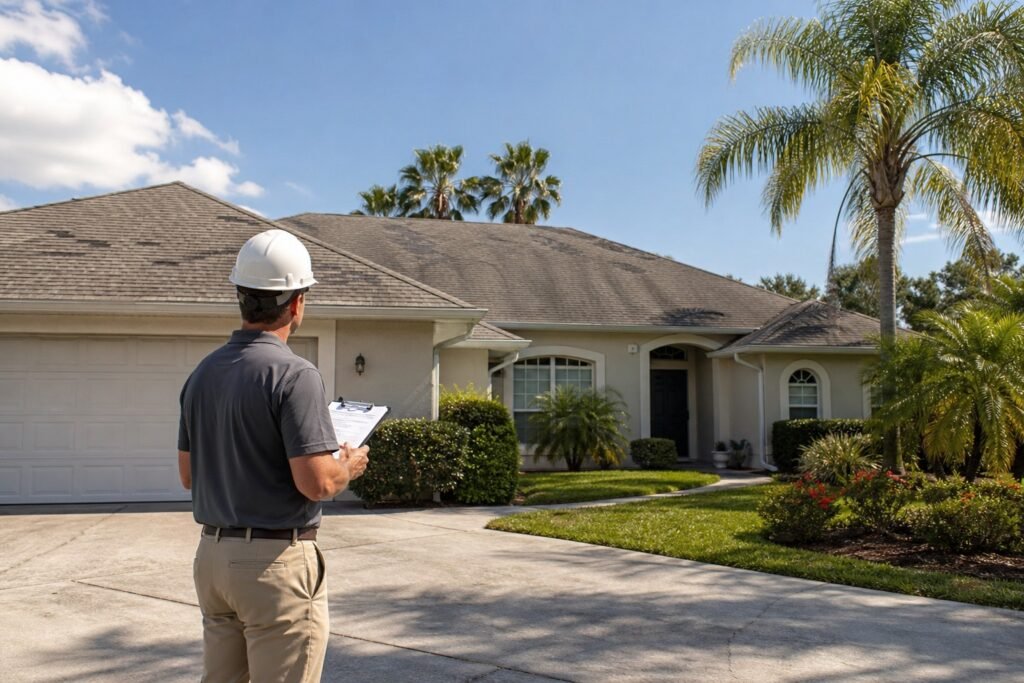
Every Tampa Bay homeowner with an aging roof faces the same question eventually: do you patch what’s broken, or do you tear it all off and start fresh? It sounds simple, but the answer depends on a tangle of factors — roof age, damage extent, insurance posture, Florida building code requirements, and basic financial math.
Get it wrong in one direction and you waste money on a dying roof. Get it wrong in the other and you spend $15,000 you didn’t need to. Here’s how to think through it like a contractor, not a gambler.
The Age Factor: Why Your Roof’s Birthday Matters More Than the Damage
In Hillsborough County’s heat and humidity, asphalt shingles realistically last 18 to 22 years — not the 25 or 30 years printed on the packaging. That lifespan is based on moderate climates, not Tampa Bay’s daily UV bombardment, 90-degree attic temperatures, and afternoon thunderstorms from May through October.
This means age is the single most important variable in the repair-vs-replace decision. A 7-year-old roof with storm damage to one slope is a clear repair candidate. A 17-year-old roof with the same damage is a different conversation entirely, because you’re spending money on a system that has 1 to 5 years of useful life remaining.
Here’s a practical age framework for asphalt shingle roofs in the Brandon, Riverview, and Valrico area:
- Under 10 years old: Almost always repair, unless damage is catastrophic. Your roof has significant life left.
- 10 to 15 years old: Repair makes sense for isolated issues — a leak at a pipe boot, damaged flashing, a few missing shingles. But start planning financially for replacement within 5 to 8 years.
- 15 to 20 years old: This is the gray zone. Every repair dollar is buying time on a system approaching end of life. Weigh repair cost against how soon replacement is coming anyway.
- Over 20 years old: Unless you have a tile or metal roof, you’re almost certainly better off replacing. Repairs at this stage are often temporary fixes on a system that’s failing systemically.
The 25–30% Cost Rule: When Repair Math Stops Working
There’s a financial rule of thumb that most experienced Tampa Bay roofers use: if the cost of repair exceeds 25 to 30 percent of what a full replacement would cost, replacement is usually the smarter investment — provided the roof is past its midlife point.
Here’s what that looks like with current Hillsborough County numbers. The average asphalt shingle roof replacement on a typical 2,200-square-foot Tampa Bay home runs roughly $12,000 to $17,000 in 2026, depending on material grade, deck condition, and accessibility (BuildFolio, July 2026). That puts the 25–30% threshold at roughly $3,000 to $5,000.
So if you’re looking at a $1,200 flashing repair on a 12-year-old roof, the math clearly favors repair. But if you’re staring at a $4,500 repair estimate on a roof that’s 16 years old, you’re spending a third of the replacement cost to extend a system that may need full replacement in 3 to 4 years regardless. That’s when the financial logic shifts.
Common Tampa Bay repairs and their typical costs:
- Minor leak or pipe boot repair: $300–$600
- Flashing repair (chimney, wall, or skylight): $300–$950
- Moderate shingle or tile repair: $600–$1,500
- Major repair with partial decking damage: $1,500–$4,500+
(Repair cost ranges based on 2026 Tampa market data from VNPS Roofing and JAE of America.)
Florida’s 25% Code Rule: When the Building Code Decides for You
Florida has a code provision that can take the decision out of your hands entirely. Under the Florida Building Code – Existing Building, Section 706.1.1, if more than 25 percent of your total roof area or roof section is repaired, replaced, or recovered in any 12-month period, the entire roof system or section must be replaced to conform to the current building code.
There’s an important exception: if your existing roof was permitted and installed under the 2007 Florida Building Code or any later edition (meaning your roof permit application date is March 1, 2009, or later), the 25% rule doesn’t force a full tear-off. Only the repaired portion needs to meet current code. For many newer homes in Brandon’s growth corridors — FishHawk, Waterset, Boyette — this exception applies.
But for homes with roofs permitted before March 2009, this rule is a hard boundary. If storm damage or deterioration affects more than a quarter of your roof area and you need to touch it, you may be required to replace the whole thing to meet code. That’s not a contractor trying to upsell you — that’s Hillsborough County’s building department enforcing state law.
The Insurance Equation: What Your Carrier Is Really Calculating
Florida’s insurance market has added an entirely new layer to the repair-vs-replace decision. Under F.S. 627.7011, carriers cannot refuse to issue or non-renew a policy solely because a roof is under 15 years old. But once your roof crosses that 15-year mark, carriers have significantly more leverage.
Here’s what that means practically for Hillsborough County homeowners:
- ACV vs. RCV coverage: Many Florida carriers now write roof coverage on an actual cash value (ACV) basis for older roofs, meaning storm damage claims pay the depreciated value — not the cost to actually fix it. A $15,000 roof replacement might net you a $6,000 ACV check after depreciation and your deductible. Repairing a roof to keep it limping along doesn’t change your ACV exposure on the next claim.
- Non-renewal pressure: Once your roof hits 15 to 20 years, some carriers will non-renew or require an inspection showing 5 or more years of remaining useful life. A cosmetic repair doesn’t reset that clock — only a full replacement does.
- Premium impact: A new roof with current wind mitigation credits can save Tampa Bay homeowners $800 to $2,200 per year on insurance premiums. Over 5 years, that’s $4,000 to $11,000 in savings that partially offset the replacement cost.
If you’re repairing a 16-year-old roof to avoid a $14,000 replacement, but you’re also losing $1,500 a year in insurance savings you’d get with a new roof and a current wind mitigation form, the five-year math tilts heavily toward replacement.
What Deck Damage Changes About the Calculation
The single factor that most often tips a repair into replacement territory is damage to the roof deck — the plywood sheathing underneath your shingles. When a roof inspector finds soft spots, rot, or delaminated plywood, the cost and scope of repair escalates fast.
Replacing decking means removing the roofing material above it, cutting out and replacing the damaged sections, then reinstalling everything. At that point, the incremental cost difference between a major targeted repair and a full replacement shrinks dramatically. If your contractor is already tearing off shingles and replacing decking over a significant area, you’re paying for most of the labor and material of a full replacement anyway — but getting a partial result.
In Hillsborough County’s climate, deck damage is common on roofs over 15 years old, especially around penetrations (pipe boots, vents, skylights) and in valleys where water concentrates. If your repair estimate includes deck replacement, get a side-by-side quote for full replacement before you commit.
The Decision Framework: Putting It All Together
Before you sign a repair or replacement contract, run through these five questions:
- How old is the roof? Under 10 years, repair almost always wins. Over 20, replacement almost always wins. Between 10 and 20, keep reading.
- What percentage of replacement cost is this repair? Under 25%, repair is usually sound. Over 30% on a roof past its midlife, replacement math is stronger.
- Does the 25% code rule apply? If your roof was permitted before March 2009 and the damage exceeds 25% of the roof area, code may require full replacement regardless.
- What’s your insurance posture? Are you on ACV coverage? Facing non-renewal? A new roof resets your insurability and unlocks premium savings worth thousands over its lifespan.
- Is there deck damage? If yes, get a full replacement quote alongside the repair estimate. The gap is often smaller than you’d expect.
The right answer isn’t always the cheapest answer today — it’s the one that costs the least over the next 5 to 10 years when you factor in insurance, future repairs, and the risk of a major storm hitting an aging system.
Need help evaluating your roof’s current condition? Brandon Roofing offers free inspections for homeowners across Tampa Bay, Brandon, Riverview, and Valrico. Call us at (813) 538-8200 to schedule yours before hurricane season peaks.
Published August 24, 2026. Costs and code references reflect 2026 data for Hillsborough County. Florida building code, insurance carrier policies, and market pricing are subject to change — consult a licensed Florida roofing contractor for current guidance specific to your property.