
What You Can Legally DIY on a Florida Roof
And What Requires a Permit
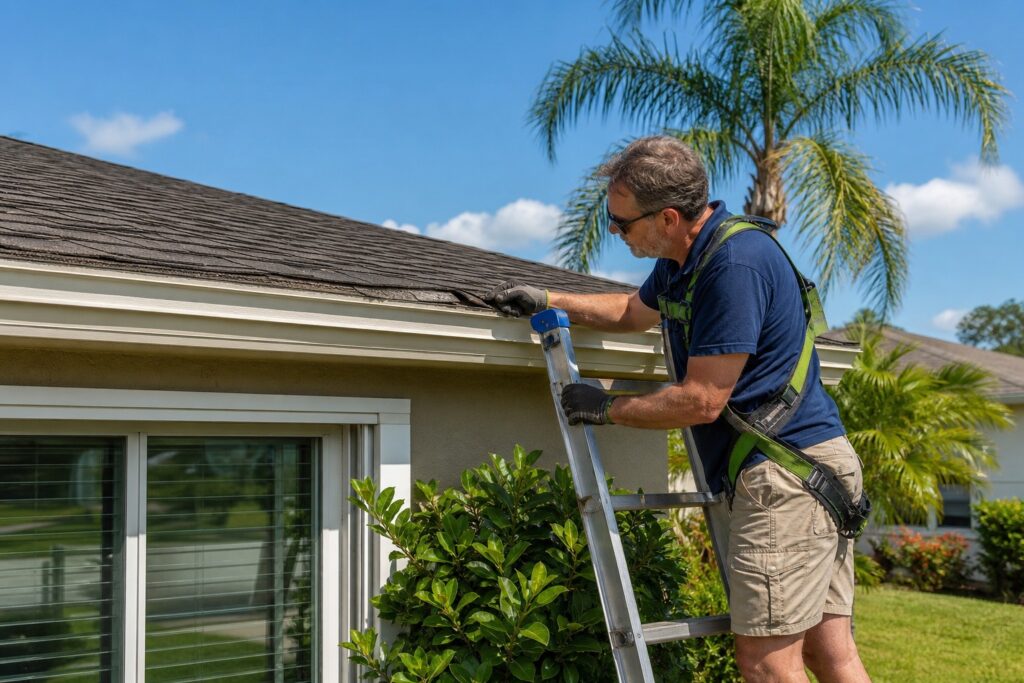
Every weekend, homeowners across Brandon, Riverview, and Valrico climb ladders to look at loose shingles, sagging gutters, or storm damage — and ask the same question: Can I just fix this myself?
The answer in Florida is surprisingly nuanced. State law does allow homeowners to do certain roofing work on their own property, but the line between a legal weekend repair and a code violation that tanks your insurance claim is thinner than you might think. Here’s what Hillsborough County homeowners actually need to know before picking up a nail gun.
The Owner-Builder Exemption: What Florida Law Actually Says
Florida Statute 489.103(7) is the key law here. It allows property owners to act as their own contractor — including for roofing work — but only under specific conditions:
- It must be your primary residence. The property has to be deeded in your name and used for your own occupancy. Rental properties, investment homes, and Airbnbs don’t qualify.
- You must personally appear and sign the permit application. In Hillsborough County, you’ll need to submit an Owner Builder Disclosure Statement through the county’s HillsGovHub portal, along with a photo ID and proof of ownership.
- You must provide direct, onsite supervision. If friends or family help, you need to be physically present and actively supervising. You cannot delegate this to someone else unless they hold a valid Florida contractor’s license.
- You cannot sell or lease the property for one year after the work is completed. If you sell within that window, the state presumes the work was done for commercial purposes — and that’s a violation.
One important detail for Hillsborough County homeowners: for single-family residences, there is no monetary limit on owner-builder work. However, commercial properties are capped at $75,000.
What You Can Do Without a Permit
Not every shingle repair requires a trip to the building department. In general, Florida allows minor cosmetic roof repairs without a permit. The City of Tampa, for example, exempts roofing work under 500 square feet from permitting requirements. Other Hillsborough County jurisdictions may set the threshold lower — some use 100 square feet as the cutoff.
Permit-exempt work typically includes:
- Replacing a handful of damaged or blown-off shingles
- Minor surface-level repairs that don’t involve underlayment, flashing, or decking
- Small patches that stay well under the 25% threshold of your total roof area
But here’s the critical caveat: if you peel back shingles and discover rotted decking, water damage, or compromised underlayment underneath, you’ve crossed into structural territory. At that point, a permit is required — even if you started with a simple repair.
When a Permit Is Non-Negotiable
Florida’s building code draws a hard line at several thresholds. You absolutely need a permit for:
- Any repair or replacement exceeding 25% of your total roof area in a 12-month period. Under the Florida Building Code’s “25% Rule,” if you cross this threshold on a roof built before the 2007 code, the entire roof system must be brought up to current code standards. For roofs installed under the 2007 code or later, only the repaired portion needs to meet current standards — but you still need a permit.
- Full roof replacements. No exceptions. Whether you’re doing it yourself under the owner-builder exemption or hiring a contractor, a permit is required.
- Changing roofing materials — for example, switching from asphalt shingles to metal or tile.
- Any structural work involving trusses, rafters, or roof decking replacement.
- Installing secondary water barriers, which are required during re-roofing in most of Florida.
In Hillsborough County, re-roofing permits require at least two inspections: a progress check after the underlayment is installed (to verify sheathing attachment and mitigation work), and a final inspection once the roof is complete. Homeowners doing their own work must schedule these inspections with the county — you can even request a virtual inspection with supporting photos and videos.
Why Unpermitted Roof Work Is an Insurance Nightmare
This is where the real consequences hit Brandon homeowners hardest. Florida insurance companies are increasingly aggressive about verifying permits, and many now use aerial imagery and public permit records to cross-reference recent roofing work.
If you do roof work without a permit and later file a claim:
- Your claim can be denied entirely. Insurers routinely deny claims on unpermitted roofs, arguing the work wasn’t inspected or doesn’t meet code. In a hurricane scenario, that could leave you holding a $15,000 to $35,000 replacement bill — or more — with zero coverage.
- Your policy can be canceled or non-renewed. Once an insurer discovers unpermitted work, they may view your property as too risky to cover. Getting new coverage with a cancellation on your record is significantly harder.
- It complicates home sales. Buyers’ insurance companies check permit records. If satellite imagery shows a new roof but no permit exists, expect demands for after-the-fact permits, code corrections, or price reductions.
Beyond insurance, Hillsborough County can impose daily fines for unpermitted work that accumulate until the violation is resolved. In serious cases, they can place a lien on your property or order the unpermitted work removed.
The Emergency Exception You Should Know About
There’s one scenario where the rules loosen slightly. Under Florida Statute 489.103(7)(a)(2), homeowners can repair or replace asphalt, fiberglass shingles, or wood shakes without a contractor’s license when the property has been damaged by a Governor-declared state of emergency — think hurricane damage.
This doesn’t eliminate the permit requirement. You still need to pull an owner-builder permit and pass inspections. But it does give homeowners in Brandon and surrounding areas legal room to make emergency repairs after a major storm without waiting weeks for a licensed contractor to become available.
The Bottom Line for Brandon Homeowners
Here’s the practical takeaway:
- Minor shingle repairs (a few tabs, well under your jurisdiction’s square-footage threshold) are generally fine to do yourself without a permit.
- Anything beyond minor patches — especially work approaching 25% of your roof area, any material changes, or any structural repairs — requires a permit. Period.
- You can legally do the work yourself under the owner-builder exemption, but you must pull the permit, sign the disclosure statement, supervise all work personally, and pass all required inspections.
- Skipping the permit is never worth it. The short-term convenience doesn’t come close to offsetting the insurance risk, the fines, and the headaches when you eventually sell.
When in doubt, call the Hillsborough County Development Services office at (813) 272-5600 before you start. They’d rather help you do it right than fine you later.
And if your roof needs more than a minor patch — or if you’d rather have a licensed professional handle the permits, inspections, and code compliance — call Brandon Roofing at (813) 538-8200 for a free roof inspection. We’ll tell you exactly what your roof needs, what requires a permit, and how to protect your investment and your insurance coverage.
Published May 27, 2026. Note: Florida building codes, permit requirements, and insurance regulations are subject to change. This article reflects current law as of the publication date. Always verify requirements with your local building department or a licensed contractor before beginning any roofing work.