
The Complete Guide to Roof Underlayment in Tampa Bay
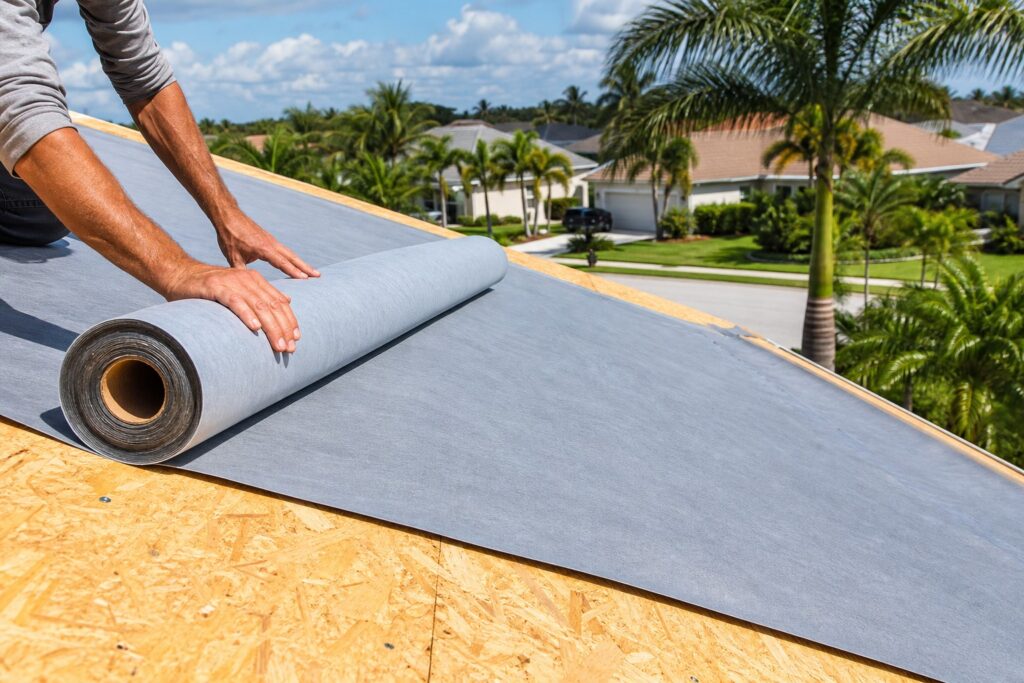
Most Tampa Bay homeowners can describe their shingles in detail — the color, the brand, how old they are. But ask about the underlayment beneath those shingles and you’ll usually get a blank stare. That’s a problem, because in Florida’s wind-and-rain climate, underlayment isn’t just a backup layer. It’s the last line of defense between a storm and the inside of your home.
If your shingles blow off in a hurricane — and shingles do blow off — underlayment is what keeps rain from pouring straight through your roof deck and into your attic, your ceilings, and your walls. Florida’s building code treats underlayment accordingly, with requirements that are among the strictest in the country. Here’s what every Hillsborough County homeowner should understand about what’s under their roof.
The Three Types of Roof Underlayment (And Which One Florida Prefers)
There are three main categories of roof underlayment used in residential roofing. Each has a different role, and Florida’s building code has increasingly narrowed which ones are acceptable.
Felt underlayment (asphalt-saturated felt). This is the traditional option — the black tar paper your grandfather’s roofer used. It comes in two weights: #15 (Type I) and #30 (Type II). The lighter #15 felt has been effectively phased out under the current Florida Building Code 8th Edition. If a contractor is still using it anywhere in the state, that’s a red flag. The heavier #30 felt (ASTM D226 Type II) is still code-compliant in some applications, but it now requires a double-layer installation — and even then, most Florida roofers have moved on. Felt tears easily, absorbs moisture, and wrinkles in Tampa Bay’s summer heat. Cost: roughly $0.10 to $0.25 per square foot.
Synthetic underlayment. This is the modern standard for Florida roofing. Made from woven or spun polypropylene, synthetic underlayment is lighter, stronger, and far more resistant to tearing and UV exposure than felt. It lays flat in high heat, repels water without absorbing it, and gives roofers a safer, less slippery surface to work on. Under the FBC 8th Edition, synthetic underlayment meeting ASTM D4869 Type III or IV — or the newer ASTM D8257 standard — is the go-to option for the main field of the roof. Cost: roughly $0.25 to $0.75 per square foot.
Peel-and-stick (self-adhering) underlayment. This is the premium option — a polymer-modified bitumen membrane that bonds directly to the roof deck without fasteners. It meets ASTM D1970 standards and creates a watertight seal that stays put even if shingles are ripped away. Florida’s building code requires peel-and-stick underlayment in specific high-vulnerability areas: roof valleys (extending at least 24 inches on each side of the centerline) and along the perimeter of the roof. In the High-Velocity Hurricane Zone — Miami-Dade and Broward counties — full-deck peel-and-stick is mandatory. Tampa Bay isn’t in the HVHZ, but many local contractors recommend full-deck coverage anyway given our hurricane exposure. Cost: $0.50 to $1.50 per square foot.
What the Florida Building Code Actually Requires in Tampa Bay
Hillsborough County falls in the 140–145 mph design wind speed zone under the current code — one step below the HVHZ threshold of 170 mph, but well above the baseline requirements for most of the country. That wind speed classification dictates specific underlayment rules for every reroof in Brandon, Riverview, Valrico, and the surrounding area.
Under the FBC 8th Edition (effective since late 2024), here’s what a code-compliant shingle roof installation in Hillsborough County requires:
- Self-adhering peel-and-stick underlayment in all roof valleys and along the roof perimeter — this is non-negotiable.
- Taped deck joints — self-adhering membrane or flexible flashing tape over all plywood seams before underlayment goes down. This is the secondary water barrier that keeps water from penetrating at the weakest points of the roof deck.
- Synthetic or #30 felt underlayment over the full field of the roof, properly fastened with cap nails at specified intervals. If using #30 felt, a double-layer application is now required.
- Enhanced nailing patterns — cap nail shanks must penetrate through the sheathing or at least ¾ inch into the roof deck.
The key change in the 8th Edition that affects Tampa Bay homeowners: the old single-layer #15 felt option is gone, and the threshold for requiring self-adhering underlayment at the perimeter and valleys has expanded. If your roof was last replaced before 2024, there’s a good chance the underlayment under your shingles doesn’t meet today’s code — and that matters when you file an insurance claim or sell your home.
Why Underlayment Matters More in Florida Than Almost Anywhere Else
In most states, underlayment is a temporary moisture barrier during construction — something to keep rain out while the roofer finishes the job. In Florida, it serves a permanent structural role as the secondary water barrier.
Here’s why that distinction matters in Hillsborough County:
- Hurricane shingle loss. A Category 1 hurricane can strip shingles from a roof in minutes. What remains — and what determines whether your home sustains $5,000 in repairs or $50,000 — is the underlayment. Peel-and-stick underlayment bonded to the deck will hold. Old felt paper fastened with staples probably won’t.
- Driving rain penetration. Tampa Bay gets roughly 50 inches of rain per year, much of it in intense summer storms. Wind-driven rain doesn’t fall straight down — it pushes laterally under shingles and into any gap it can find. Quality underlayment with properly sealed laps is what stops it.
- Insurance inspections. Carriers in Hillsborough County increasingly ask about underlayment as part of four-point and wind mitigation inspections. A roof with documented peel-and-stick underlayment may qualify for better wind mitigation credits than one with unknown or outdated underlayment.
- UV degradation. If shingles are damaged or removed, underlayment may be exposed to Florida’s intense UV radiation for days or weeks while you wait for a contractor. Synthetic and peel-and-stick underlayment tolerate UV exposure far better than felt, which deteriorates rapidly in direct sun.
How to Find Out What’s Under Your Shingles Right Now
If your roof was replaced under permit in Hillsborough County, the underlayment type should be documented in the permit records. During every permitted reroof, the county requires a “dry-in” inspection — the inspector verifies that underlayment is fully installed and all penetrations are sealed before the contractor is allowed to install the final roof covering. That inspection record is part of the permit file.
You can look up your permit records through the Hillsborough County Development Services portal or call them at (813) 272-5600. The permit file should include the contractor’s scope of work listing the underlayment product used.
If your roof was replaced without a permit — and unfortunately, this is not uncommon in Florida — there’s no reliable way to verify the underlayment without physically lifting shingles, which is something a licensed contractor can do during a routine inspection. If you’re buying a home, especially a flip, ask the seller to provide the original roofing permit and the dry-in inspection record. If they can’t produce it, you should assume the underlayment is an unknown risk.
What to Ask Your Contractor Before Your Next Reroof
When you get quotes for a roof replacement in the Brandon area, underlayment should be a specific line item in every estimate — not buried in a generic “materials” category. Here’s what to ask:
- What underlayment product are you using, and what ASTM standard does it meet? You want to hear specific product names and standard numbers (D1970 for peel-and-stick, D4869 or D8257 for synthetic), not vague descriptions.
- Are you applying peel-and-stick in the valleys, perimeter, and over deck joints? This is code-required. If a contractor skips it, they’re cutting corners on the most critical waterproofing step.
- Will the underlayment be installed before the dry-in inspection? A reputable contractor pulls the permit and schedules the dry-in inspection so the county verifies the underlayment before shingles go on. If they don’t mention this step, ask why.
- Would you recommend full-deck peel-and-stick for my home? It’s not code-required in Hillsborough County, but for a home in a high-exposure area or with a roof geometry that creates vulnerability to wind-driven rain, the additional $1,500 to $3,500 investment can be the difference between surviving a storm with dry interiors or dealing with catastrophic water damage.
Underlayment isn’t the glamorous part of a roofing project. You’ll never see it once the shingles go on. But in Tampa Bay, it’s arguably the most important layer on your roof — and the one most worth understanding before you sign a contract.
Need to know what’s under your current roof — or ready to plan a replacement with the right underlayment for Hillsborough County’s wind zone? Call Brandon Roofing at (813) 538-8200 for a free inspection and honest assessment.
Published July 18, 2026. Underlayment requirements are governed by the Florida Building Code 8th Edition (2023), currently in effect. Code requirements may change with future editions. Always confirm current requirements with your contractor and local building department.