
Algae, Mold and Moss: Tampa Bay’s Humidity Problem and What It’s Doing to Your Roof Right Now
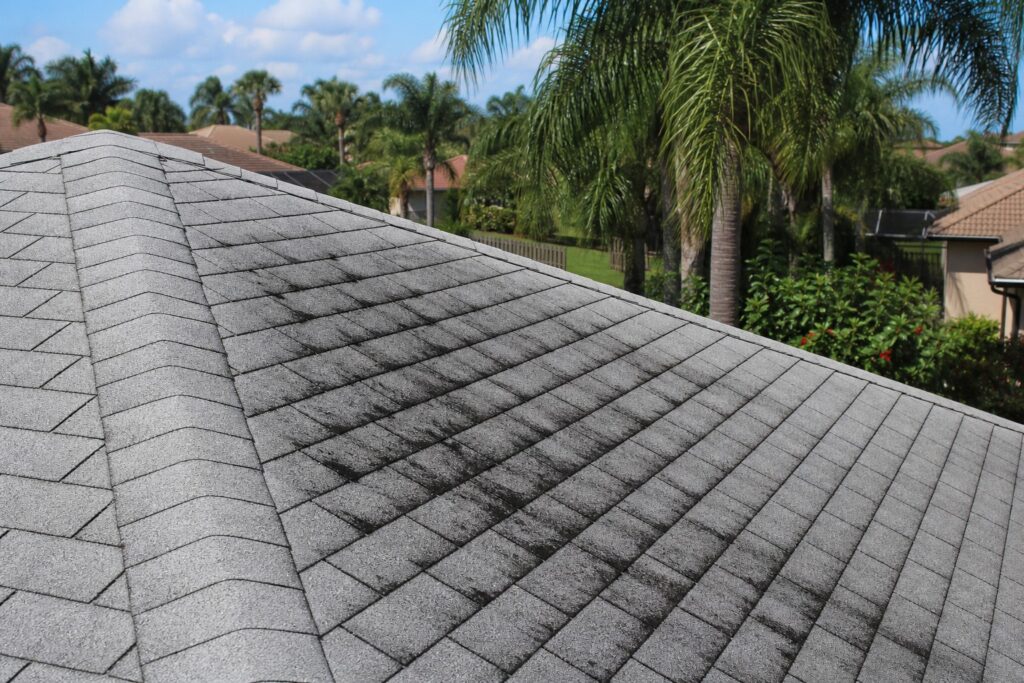
If you’ve noticed dark streaks running down your roof, you’re not alone. Drive through any neighborhood in Brandon, Riverview, or Valrico and you’ll see it — dark staining on roof after roof, most visible on lighter-colored shingles. Most homeowners assume it’s dirt or normal aging. It’s not. Those streaks are alive, and in Tampa Bay’s subtropical humidity, they’re thriving.
Here’s what’s actually happening on your roof, what the different types of growth mean, and what works — and what doesn’t — to deal with it. Published June 10, 2026.
The Black Streaks Are Bacteria, Not Dirt
The dark streaks you see on asphalt shingle roofs are caused by a cyanobacterium called Gloeocapsa magma. Despite being commonly called “roof algae,” it’s technically a photosynthesizing bacterium — an ancient organism that feeds on the calcium carbonate in your shingles’ limestone filler and on the moisture that Tampa Bay’s air provides in abundance.
As the colony grows, it produces a dark, UV-protective outer coating. That’s the black staining you see. It always appears as downward streaks because rainwater spreads the bacteria as it runs off the roof.
Tampa Bay’s climate is essentially a paradise for Gloeocapsa magma. Our average relative humidity runs around 75 percent year-round, peaking above 88 percent on summer mornings. June through September dumps roughly 30 inches of rain on Hillsborough County. Warm, wet, and consistent — it’s exactly what these organisms need to colonize every asphalt shingle roof in the area.
Algae vs. Moss vs. Mold: Three Different Problems
Homeowners tend to lump all roof growth together, but algae, moss, and mold are different organisms with different implications for your roof:
Algae (Gloeocapsa magma): The most common culprit in Tampa Bay. It appears as flat, dark streaks. On its own, algae is mostly a cosmetic issue at first — but over time, it retains moisture against the shingle surface, accelerating granule loss. Granules are the tiny mineral coating that protects your shingles from UV damage. Once they’re gone, shingle deterioration speeds up dramatically.
Moss: Less common in inland Hillsborough County than in shadier, cooler climates, but it shows up on north-facing slopes and under tree canopy. Moss is the more aggressive threat — its root-like structures lift shingle edges, allowing water to get underneath. If you can see thick green growth on your roof, that’s a problem that needs attention soon.
Mold and mildew: True mold typically grows on the underside of roofing — in the attic or on the decking — where ventilation is poor and moisture is trapped. If you see dark patches on your ceiling rather than your roof exterior, you may have a mold problem that signals a leak or a ventilation failure. This is the one that can become a health issue and should be addressed immediately.
When Algae Signals Something Deeper
Most contractors will tell you that algae alone isn’t an emergency. That’s true — to a point. The issue is that in our climate, algae is rarely the only thing happening. Here’s what to watch for:
- Granule accumulation in your gutters. Some granule loss is normal on any asphalt roof. But if you’re seeing heavy accumulations, especially combined with visible streaking, your shingles are losing their protective layer faster than they should.
- Uneven staining patterns. If some areas of your roof are significantly darker or more stained than others, it may indicate areas where moisture is pooling or draining poorly — a structural concern beyond just algae.
- Shingles that feel spongy or soft. If a roofer tells you your shingles feel “mushy,” that means moisture has penetrated the shingle mat. At that point, you’re past cleaning — you’re looking at replacement.
- Curling or lifting shingle edges. Algae-related moisture retention can accelerate shingle curling, especially on roofs already past the 12- to 15-year mark. Curling edges are entry points for wind-driven rain.
The bottom line: algae is the visible symptom. The real question is what it’s been doing to your shingles while you assumed it was just dirt.
What Actually Works — and What Contractors Upsell
Soft washing works. The Asphalt Roofing Manufacturers Association (ARMA) recommends a 50/50 mix of household bleach and water, applied at low pressure. Professional soft wash services in the Tampa Bay area typically cost $300 to $600 for a standard home. This kills the bacteria on contact without damaging the shingle surface.
Pressure washing does not. This is the single biggest mistake homeowners make. A pressure washer will strip granules off your shingles faster than a decade of algae ever could. Any roofer or cleaning company that suggests pressure washing an asphalt shingle roof either doesn’t know better or doesn’t care. Walk away.
Zinc and copper strips help prevent regrowth. Installed along the roof ridge, these metal strips release trace ions when it rains, creating an environment that inhibits new algae colonies. They won’t remove existing staining, but after a soft wash, they can extend the time between cleanings by several years. A licensed roofer can install them during a maintenance visit.
Algae-resistant (AR) shingles are worth considering at replacement time. Major manufacturers now offer shingles with copper-infused granules that resist algae growth. If your roof is due for replacement in the next few years, AR shingles are a smart investment for any home in Hillsborough County. They typically come with a 10- to 15-year algae resistance warranty.
Tree trimming matters more than you think. Shade plus moisture equals algae. Trimming branches back from your roofline improves airflow and sunlight exposure — two things algae doesn’t like. It’s one of the simplest, cheapest things you can do for roof longevity in Brandon’s tree-heavy neighborhoods.
The Insurance Angle Brandon Homeowners Should Know
Here’s where algae becomes more than a cosmetic issue. Many Florida homeowners insurance carriers now include cosmetic damage exclusions in their policies. Algae staining alone is almost universally classified as cosmetic — meaning your carrier won’t pay to address it.
But the damage that algae accelerates — granule loss, moisture intrusion, premature shingle failure — is functional damage. The problem is proving the connection. If you wait until your shingles fail and then file a claim, your adjuster may argue the damage was caused by lack of maintenance, not a covered event.
The takeaway: document your roof’s condition now. Take dated photos, keep records of any cleaning or maintenance, and get a professional inspection if your roof is showing heavy staining and is more than 10 years old. That documentation protects you if you need to file a claim later — and it gives you honest information about how much life your roof has left.
What to Do This Week
Tampa Bay just entered the wettest part of the year. If your roof has visible dark streaking, here’s a simple action plan:
- Look at your gutters. Heavy granule buildup is a sign your shingles are aging faster than they should.
- Check your attic. Look for dark spots on the underside of the decking or any musty smell — signs of moisture intrusion.
- Get a professional assessment. A quick roof inspection can tell you whether you’re dealing with surface algae that needs a cleaning, or deeper deterioration that needs a plan.
- Don’t pressure wash. If you do nothing else, remember this: never pressure wash an asphalt shingle roof.
Algae is the most common roof issue in Hillsborough County that homeowners don’t take seriously — until it’s too late. A $400 soft wash today can save you thousands in accelerated shingle replacement down the road.
If you’re not sure what’s happening on your roof, give Brandon Roofing a call at (813) 538-8200 for a free inspection. We’ll tell you what we see, what it means, and what — if anything — you need to do about it.