
Tampa Bay’s Worst Hail Events: What They Damaged and What Insurance Actually Covered
Published August 22, 2026. Insurance coverage details reflect Florida law and carrier practices as of the publication date. Policies, statutes, and carrier guidelines change — consult your agent or a licensed public adjuster for advice specific to your situation.
Most Tampa Bay homeowners don’t think about hail. We think about wind. We think about rain. We think about the next named storm spinning across the Gulf. But hail happens in Hillsborough County more often than most people realize — and when it does, the roof damage it causes sits in a frustrating gray zone between what’s real and what your insurance company is willing to pay for.
Florida averages more than 100 hail events per year, according to NOAA’s Storm Prediction Center. Most are small — pea- or marble-sized stones that rattle your car and disappear. But several events in recent years dropped hail large enough to crack shingles, dent metal roofing, and trigger thousands of insurance claims across the Tampa Bay region.
Here’s a look at the most significant hail events to hit our area, what they actually damaged, and what homeowners learned about their insurance coverage the hard way.
The Events That Hit Closest to Home
April 24, 2023 — 3-Inch Hail in Thonotosassa
This is the one locals still talk about. On April 24, 2023, a severe thunderstorm dropped 3-inch-diameter hailstones — hockey-puck-sized — in the Antioch community east of Thonotosassa in Hillsborough County. The NOAA Storm Prediction Center confirmed the report with photographic evidence, and additional quarter-size hail was reported near the Hillsborough River area the same afternoon.
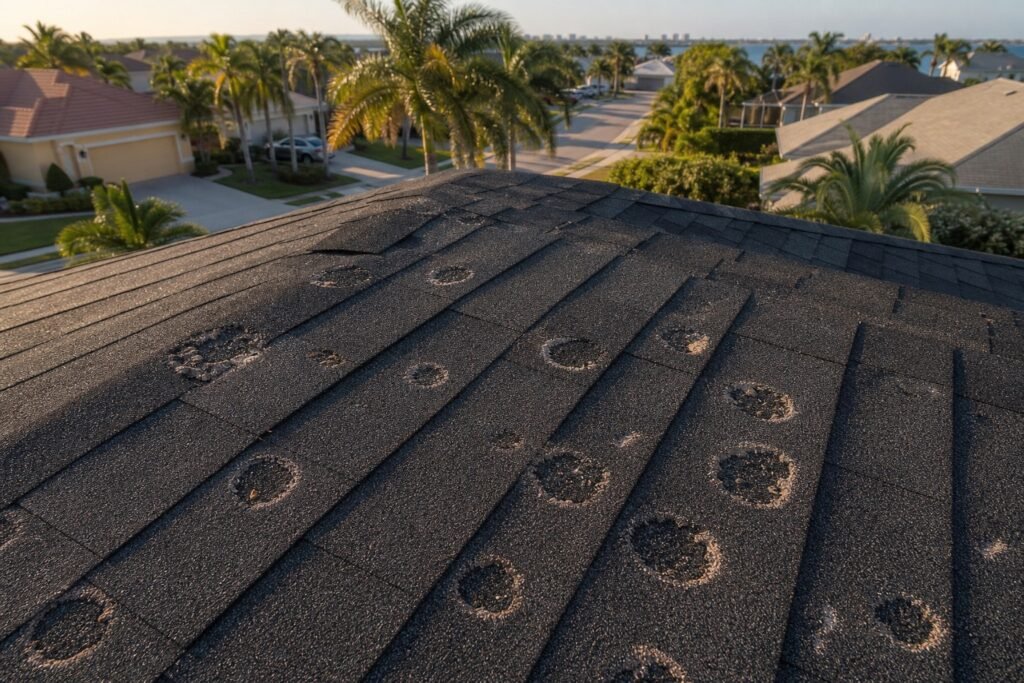
At 3 inches, hailstones don’t just dent — they puncture. Asphalt shingles sustain fractures in their fiberglass reinforcement mat. Metal roofing gets permanent deformation. Gutters, soffits, and window screens take direct hits. Cars parked outside came away with shattered windshields and body panel damage. An estimated 555 properties were in the storm’s impact zone, according to HailTrace mapping data.
June 2, 2025 — 1.5-Inch Hail Along I-4
Just over a year ago, a storm dropped 1.5-inch hail — ping-pong-ball-sized — near the intersection of I-4 and Highway 301, right in the East Lake-Orient Park area of Hillsborough County. Quarter-size hail was also reported near the Florida State Fairgrounds the same afternoon, per NOAA SPC storm reports.
This event hit close to Brandon, Riverview, and Valrico — and for homeowners with roofs already showing wear, 1.5-inch hail is well above the threshold for functional damage to asphalt shingles.
May 3–4, 2005 — The Supercell No One Expected
This one goes in the history books. On May 3, 2005, a genuine supercell thunderstorm — the kind of rotating storm you’d expect in Oklahoma, not Florida — tracked through the Tampa Bay region. The NWS Tampa Bay office documented the event as producing up to baseball-size hail (nearly 3 inches) in the surrounding counties, with golfball-size hail confirmed in Hardee and Polk counties. The following morning, additional hail-producing storms crossed north Pinellas and south Pasco.
The NWS called it “an unusual late-season event, more typical in Oklahoma than in Florida in May.” It produced what was, at the time, one of the best-documented supercell signatures in West Central Florida radar history.
March 25–26, 2016 — A Multi-Day Hail Siege
A series of fronts swept through Florida between March 24 and 30, 2016, bringing repeated rounds of hail to Hillsborough County on back-to-back days. The Florida Climate Center documented up to one-inch hail in Hillsborough County on both March 25 and March 26, part of a statewide event that generated 242 severe weather reports in the second half of the month alone.
One-inch hail may not sound dramatic, but it’s at the threshold. Forensic engineering research from HAAG Engineering — the industry standard for hail damage assessment — shows that asphalt shingles in mid-life or better condition typically sustain functional damage from hailstones approximately 1 to 1.25 inches in diameter. Older or deteriorated shingles can be damaged by stones as small as three-quarters of an inch.
What Hail Actually Does to a Tampa Bay Roof
Hail damage to roofing isn’t always what homeowners expect. Here’s what happens at different sizes:
- Under 1 inch (pea to quarter-size): Typically cosmetic — minor granule displacement on asphalt shingles, surface dings on metal. Unlikely to cause leaks on a healthy roof, but can accelerate aging on shingles already past mid-life.
- 1 to 1.5 inches (quarter to ping-pong-ball): The damage zone. Fractures in the fiberglass reinforcement mat of asphalt shingles (often invisible from the ground), cracked or loosened granule coverage that exposes asphalt to UV, dented metal panels with compromised coatings.
- 1.5 inches and above (ping-pong-ball to baseball): Functional damage that compromises waterproofing. Cracked shingles, punctured underlayment, dented flashing, broken ridge caps. At 3 inches, you’re looking at potential deck damage underneath.
The tricky part in Hillsborough County is that hail damage often compounds existing wear from our UV exposure, humidity cycles, and thermal expansion. A roof that was “fine” before a hailstorm may have had shingles already weakened by years of Florida sun — and the hail pushes them past the failure point.
What Insurance Covered — and What It Didn’t
This is where most Tampa Bay homeowners get an unpleasant education. Standard Florida homeowners insurance covers hail as a weather peril, the same as wind. Your policy should cover damage to the dwelling, other structures, and personal property. But the actual payout depends on several factors that many homeowners don’t discover until they file:
Cosmetic Damage Exclusions
This is the single biggest obstacle for Florida hail claims. A growing number of carriers include cosmetic damage exclusions that allow them to deny coverage for damage affecting appearance but not immediate function. Hail dents in metal roofing, dings in gutters, pockmarks on vinyl siding — all of it can be classified as “cosmetic” and denied.
The problem: the line between cosmetic and functional isn’t clear-cut. Hail that dents a metal panel may not cause an immediate leak, but it compromises the protective coating, accelerates corrosion, and shortens the roof’s useful life. Whether your insurer can deny the claim depends on your specific policy language — and most homeowners have never read that section.
ACV vs. Replacement Cost
Some Florida policies pay hail claims on an actual cash value (ACV) basis rather than full replacement cost. ACV deducts for depreciation, meaning the insurer factors in the age and condition of your roof. If your 18-year-old shingles get hail damage, an ACV payout may cover only a fraction of the replacement cost.
The One-Year Filing Deadline
Since SB 2-A took effect in December 2022, Florida homeowners have one year from the date of loss to file a new or reopened property insurance claim, and 18 months for a supplemental claim (per F.S. 627.70132). That’s down from two and three years, respectively. Hail damage is easy to miss from the ground — by the time a roofer spots it during an unrelated inspection, the filing window may have closed.
What Tampa Bay Homeowners Should Do After a Hailstorm
If you hear hail hitting your roof in Brandon, Riverview, Valrico, or anywhere in Hillsborough County — even if it sounds small — take these steps:
- Document immediately. Photograph any hail on the ground with a coin or ruler for scale. Record the date, time, and duration. Video is even better.
- Check NOAA storm reports. The Storm Prediction Center archives every confirmed hail report by date and county. If your area shows up, that’s official documentation for a claim.
- Get a professional inspection within 30 days. A licensed roofing contractor can identify hail damage that’s invisible from the ground — the fractures in shingle mats, the granule loss patterns, the dented flashing. Don’t wait until a leak appears.
- Read your policy’s hail and cosmetic damage language before filing. Know whether you have replacement cost or ACV, and whether a cosmetic exclusion applies.
- File within the one-year deadline. Don’t let the clock run out. Even if damage seems minor, filing preserves your right to a full claim if problems develop.
The Bottom Line
Tampa Bay doesn’t get the relentless hail that hammers the Texas Panhandle or Colorado’s Front Range. But when hail does hit Hillsborough County, it tends to catch homeowners off guard — and the insurance process that follows is often more painful than the storm itself. Cosmetic exclusions, ACV payouts, and tight filing deadlines mean the gap between what hail damages and what insurance covers is wider than most people expect.
If your roof has been through any of the events listed above — or any storm that dropped hail bigger than a quarter — it’s worth having a licensed contractor take a look. The damage doesn’t always show from the ground, and the clock on your filing deadline doesn’t wait for a leak to appear.
Brandon Roofing offers free hail damage inspections for homeowners across Brandon, Riverview, Valrico, and greater Hillsborough County. Call (813) 538-8200 to schedule yours before the next storm rolls through.