
Flat Roofs in Florida: Why Tampa Bay’s Commercial Buildings Have Different Rules
Published July 4, 2026 · Brandon Roofing
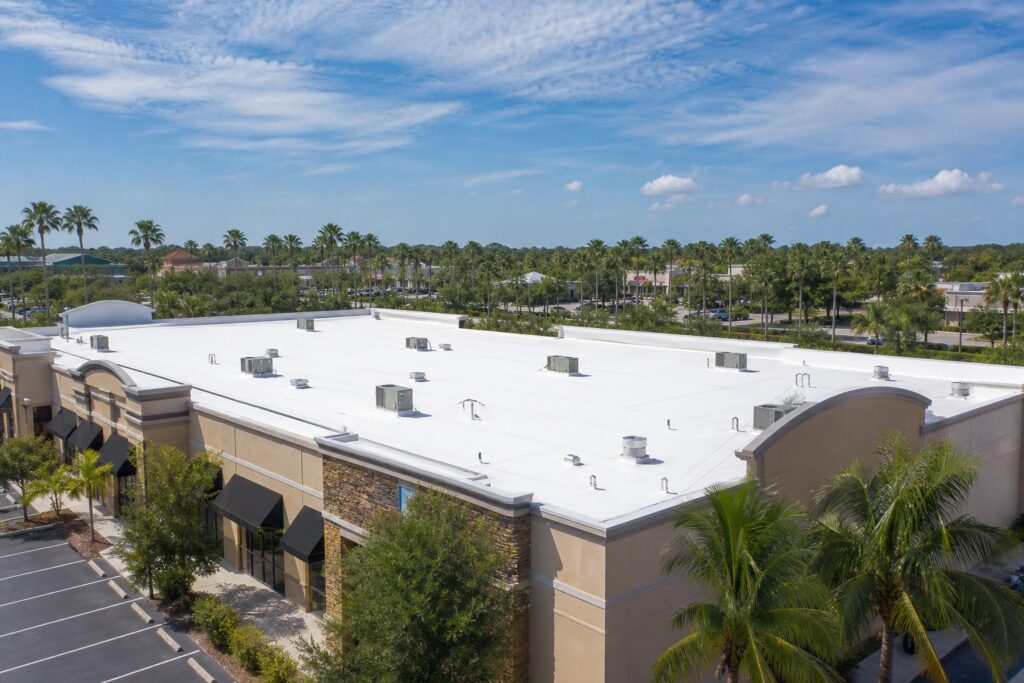
Drive through any commercial corridor in the Tampa Bay area—Brandon’s strip malls along SR 60, the medical offices off Lithia Pinecrest Road, Riverview’s growing retail clusters on Big Bend—and you’ll notice something you rarely see on the houses behind them: flat roofs.
Flat and low-slope roofs are everywhere on Tampa Bay’s commercial buildings. They work differently than the pitched shingle roofs on most Hillsborough County homes, they fail differently, and they’re governed by a separate set of Florida Building Code requirements that most homeowners never think about—until they’re looking at a commercial-to-residential conversion or buying a property with a flat roof section.
Here’s what Brandon and Tampa Bay area homeowners should understand about flat roofing in Florida, why it behaves differently in our climate, and what to watch for.
What Makes a “Flat” Roof Different Under the Florida Building Code
The Florida Building Code defines a low-slope roof as anything with a pitch below 2:12—that is, less than two inches of rise for every twelve inches of horizontal run. Most commercial flat roofs sit closer to ¼:12 or ½:12, which is essentially flat with just enough slope to move water toward drains.
This matters because the FBC treats low-slope and steep-slope systems as entirely different animals. The code volumes that govern your home’s shingle roof (FBC-Residential, based on the International Residential Code) don’t apply to most commercial flat roofs. Those fall under FBC-Building (based on the International Building Code), with different material requirements, underlayment standards, and inspection protocols.
Key differences include:
- Only one layer allowed. Unlike asphalt shingles, where Florida permits one re-roof over an existing layer, flat roofing systems like TPO, modified bitumen, and built-up roofs generally allow only a single layer. If a flat roof needs replacement, it’s a full tear-off to the deck.
- Drainage requirements are stricter. The code requires positive drainage—water must move toward drains and not pond on the surface for more than 48 hours after rain. In Tampa Bay, where summer afternoon storms can dump two or three inches in an hour, this standard is constantly being tested.
- Wind uplift testing. Flat roofs must meet specific wind uplift resistance standards, and in Hillsborough County’s wind zone, that means the membrane attachment—whether mechanically fastened, fully adhered, or ballasted—has to meet higher performance thresholds than many homeowners expect.
Three Flat Roof Systems You’ll See Across Tampa Bay
Most commercial flat roofs in the Brandon and greater Tampa Bay area use one of three membrane systems. Each handles Florida’s heat, UV, and rainfall differently.
TPO (Thermoplastic Polyolefin)
TPO is the most common new-installation flat roofing material in Florida right now. It’s a white, single-ply membrane that reflects sunlight effectively—a major advantage in a state where a dark flat roof surface can reach 170°F on a July afternoon. TPO seams are heat-welded, which creates strong, watertight bonds when done correctly.
The catch: TPO quality varies significantly by manufacturer and thickness. The minimum residential specification should be 60-mil; anything thinner should raise questions. And because seam integrity depends entirely on the installer’s technique and welding equipment, a poorly installed TPO roof leaks just as readily as any other failed membrane.
Modified Bitumen
Modified bitumen (mod-bit) is the workhorse of commercial flat roofing in Florida. It uses layers of asphalt-based material modified with rubber or plastic polymers to improve flexibility and durability. In Tampa Bay, SBS-modified (styrene-butadiene-styrene) is generally preferred over APP-modified because SBS stays more flexible in our heat cycles.
The most common failure point on modified bitumen roofs is the lapped seams—where sheets overlap and are bonded by torch, hot mop, or cold adhesive. Seams that are under- or over-fused during installation will eventually separate under Florida’s UV bombardment and thermal cycling. Dark granule-surfaced mod-bit also runs significantly hotter than white TPO, which accelerates aging. If you’re looking at a building with mod-bit in Hillsborough County, ask whether a reflective coating or cool-coat cap sheet was used.
Built-Up Roofing (BUR)
Built-up roofs—the classic “tar and gravel” systems—are less common on newer buildings but still cover a significant number of older commercial structures across Tampa Bay. BUR uses alternating layers of bitumen and reinforcing fabric, topped with gravel or a cap sheet. These systems are durable when properly maintained but are heavy, difficult to repair, and prone to blistering in Florida’s sustained heat.
Why Flat Roofs Fail Faster in Tampa Bay
Every roofing material degrades faster in Florida than in northern climates, but flat roofs face three compounding challenges that are especially pronounced in Hillsborough County:
Ponding water. This is the single biggest threat to any flat roof. Water that remains on the roof surface 48 hours after rain accelerates membrane deterioration regardless of the material. Tampa Bay’s rainy season—which typically runs from June through October—delivers massive volumes of water in short bursts. If the roof doesn’t drain properly because of inadequate slope, blocked drains, or structural deflection over time, ponding is almost guaranteed.
UV degradation. Florida’s UV intensity is among the highest in the continental United States. A flat roof gets no slope relief from direct sun exposure. Over time, UV breaks down the chemical bonds in membrane materials, causing cracking, chalking, and loss of flexibility. This is why white, reflective membranes like TPO have become the default choice in our market.
Thermal cycling. A flat roof in Brandon can swing from 170°F during a summer afternoon to 75°F after a thunderstorm rolls through—a 95-degree temperature change in under an hour. This constant expansion and contraction stresses every seam, flashing, and penetration point on the roof.
Additionally, warm, humid air rising from inside the building condenses within the roof assembly, degrading insulation and promoting mold or rot in the deck. Proper vapor barriers and ventilation are critical—and often overlooked in older Tampa Bay commercial buildings.
Why Commercial-to-Residential Conversions Deserve Extra Scrutiny
As Tampa Bay’s real estate market evolves, we’re seeing more commercial properties converted to residential use—loft apartments above storefronts in downtown Brandon and Tampa, warehouse conversions, and mixed-use developments throughout Hillsborough County. These conversions almost always involve a flat or low-slope roof, and homeowners need to understand what that means.
When a building changes occupancy from commercial to residential, the Florida Building Code’s 50-percent rule comes into play. If the renovation scope exceeds 50 percent of the building’s value, the entire structure—including the roof—must be brought up to current code. That means a 1980s warehouse roof that’s been patched for decades may need a complete replacement with a system that meets today’s wind uplift, drainage, and energy code requirements.
What to ask before buying a converted property with a flat roof:
- When was the roof last replaced—not repaired, but fully replaced?
- What membrane system is currently installed, and what thickness?
- Were permits pulled for the conversion and for any roof work? (Check Hillsborough County Development Services.)
- Is there an active maintenance agreement? Flat roofs require scheduled maintenance—typically semi-annual inspections and drain clearing—that most residential homeowners aren’t accustomed to.
- What does the insurance policy say about flat roof coverage? Some Florida carriers exclude or limit coverage for flat roof structures, or require more frequent inspections.
The Bottom Line for Tampa Bay Homeowners
Most Hillsborough County homeowners will never need to think about flat roofing—until they do. Whether you’re considering buying a property with a flat roof section, evaluating a mixed-use conversion, or simply wondering about the commercial building next door, understanding how these systems work in Florida’s climate puts you ahead of most buyers and owners.
Flat roofs aren’t inherently problematic. They’re just different—different materials, different maintenance requirements, different code standards, and different failure patterns than the pitched shingle roof on a typical Brandon home. In Florida’s heat, UV, and rain environment, those differences matter more than they do almost anywhere else.
If you have questions about a flat or low-slope roof on a property in the Brandon, Riverview, or Valrico area, Brandon Roofing can help you evaluate what you’re looking at and what it’s going to need. Call us at (813) 538-8200 for a free consultation.
Disclaimer: Building codes, insurance requirements, and material specifications change. This article reflects information current as of July 2026. Consult a licensed Florida roofing contractor and your insurance agent for guidance specific to your property.